Showing posts with label sondorgo. Show all posts

26 Nov 2015

What the audience says: Söndörgö

Utter privilege to see @sondorgo in London tonight. Five *outstanding* musicians, interplanetarily good music.

Fabulous concert @sondorgo @makingtracks_uk superb musicianship. Catch them if you can!!

Blisteringly good gig from @sondorgo @RichMixLondon

Great show tonight at Bury St Edmund's. You are fantastic musicians. Thank you very much.

Another amazing performance. This time in Cambridge. Brilliant musicians.

Hungarian band @sondorgo were brilliant tonight performing at Gateshead Old Town Hall. Catch them on the @makingtracks_uk tour - great!

Incredible concert in Brighton tonight!

Loved the gig last night; thank you! Your musicianship is incredible and you successfully communicated your joy of playing this uplifting music together. Good luck with the rest of the tour.

Thanks for such a great night @RNCM! I can't wait for the next time you're in Manchester. I'm going to love all of my CDs!

Fantastic concert in Gateshead. We loved it!

Hungarian folk band SöNDöRGő were fantastic at NCEM York tonight. See them at @RichMixLondon Friday if you can!

Söndörgö were really great on Friday night, audiences absolutely loved them.Great choice!

Was a great show, loved it!

Amazing Brighton gig. Highly recommend!

We saw you play last night in Bristol, thank you for such a wonderful evening of music, we look forward to your return.

amazing amazing gig. thank you. one song was particularly moving for me...felt like an entire journey in one song...would love to hear it again. thank you! xx

The Bristol gig was amazing, thank you so much!

brilliant gig (...) loving the band!

Great evening / nagyszeru est!

The audience were clearly very impressed with the band who were incredible musicians and clearly very happy to be on tour.

Great evening at @CambJunction listening to @sondorgo (included variations by Bartók and Vujicsics). Now lusting after a hulusi!

Fabulous music happening NOW @sondorgo @RichMixLondon

@sondorgo @RichMixLondon It was a fantastic evening.

Photo: The Orbital Strangers Project

Live review: Söndörgö at NCEM

By David Forsdike

The Making Tracks tours are all about introducing British audiences to music from less-well known corners of the globe, and last night at the NCEM in York the audience was treated to a scintillating live performance from a Hungarian quintet, Söndörgö. These five Hungarians have this music in their blood - there are three brothers in the group, along with a cousin and a family friend – and the father of the brothers, Kalman Eredics was a founder member of the group Vujicsics. Joe Boyd’s label Hannibal Records released a Vujicsics album of Serbian music from Southern Hungary in 1988, and it is this same repertoire which Söndörgö re-create with such panache today.

These musicians may be Hungarians, but there is no violin or cimbalom here. Their instruments are tamburas of various sizes, which they have mastered to a high level of virtuosity. The smallest is the size of a ukulele, but in the hands of the group’s leader Aron Eredics, the eldest of the three brothers, it demonstrated a myriad of emotions, sometimes slow and ever so slightly mournful, but more often than not ending in a joyful torrent of cascading notes across its small soundboard - this is after all music for dancing!

The line-up of instruments was ever-changing. Sometimes there were string only pieces, others featured clarinet, flute, saxophone or trumpet solos; the accordion stole the limelight at times, and engaged in frantic duets with the lead tambura, revealing a tightness of ensemble and infectious energy which was simply breathtaking. Was this the intuitive precision and collaborative musicianship that only fellow family members can provide? Their repertoire included Gypsy songs, Macedonian tunes with an Oriental flavour, and some smaller scale duos featuring tunes collected by Bela Bartok; at times they even added some hearty vocals to the mix.

One of the real joys of the evening was the chance to witness a true acoustic performance. This has become such a rarity in this day and age, and it was a real delight to hear Söndörgö’s music fill the NCEM without any amplification. Lighting was used sparingly, and enhanced the occasion without being obtrusive. These musicians were truly enjoying themselves. A highlight of the evening came after the interval with a magical piece for tamburas alone. This featured slow moving chordal harmonies ending in the most delicate of all pianissimos as the lights faded to nothing. Truly memorable!


15 Nov 2015

Live review: Söndörgö at RNCM (2)

By Ellie Sherwood

Söndörgö’s performance at the RNCM last night marked the start of their tour of the UK. I was completely blown away by the passion and talent that emitted from all five musicians on stage, who kept us entertained by their virtuosic and superb playing right until the last note. Coming from a small Hungarian town near Budapest, Söndörgö create a refreshing and unique Balkan sound which is heavily inspired by Southern Slavic folk music. The band are motivated to preserve musical traditions of the Serbs and Croats as found in different settlements in Hungary, and through this renewal of folklore and heritage, they produce inimitable music that sounds both old and new; an echo of the past heard within the present.
The traditional Balkan instrument, the tambura, was played to its absolute maximum during last night’s gig. Similar to the mandolin, the tambura is a small and agile plucked instrument, and I have never seen or heard a dainty instrument be used in such a powerful and spritely way. Each member of Söndörgö played at least three different instruments during their performance such as the tambura, wooden whistle, guitar, double bass, trumpet, clarinet, saxophone, hand drum and accordion. It seemed every piece had a different set-up of instruments, and often a musician would swap instruments half way through a song. It was exciting to see such versatile musicians performing, and what was equally impressive was that Söndörgö’s unique sound did not once falter, despite all these exciting changes. They also enlivened us with singing a couple of traditional Hungarian tunes – whilst playing and swapping instruments, of course.
Perhaps the most impressive part of Söndörgö concert was the musicians’ ability to respond to the musical spontaneity of each other. They were obviously well-rehearsed and extremely tight, but there was very much still an element of surprise and impulsiveness that only comes from musicians who perform from their hearts every time. Söndörgö were playing for us, but they were also playing for themselves, and it was obvious that they were pushing the boundaries of their own music whilst on stage. Part of their ability to do that might come from the fact that four out of five of the musicians are related – three of them being brothers, and one being a cousin – but most of their talent is rooted in their skill of listening and watching each other whilst also listening to themselves. Their musicianship and talent provided the audience with an incredibly enjoyable and remarkable evening, and one also cannot forget Söndörgö’s use of stage lighting, which added an exclusive touch the their performance.
Thank you Söndörgö, and good luck with the rest of your tour!

Live at RNCM

30 Oct 2015

New podcast - featuring Söndörgő!

The new Making Tracks podcast is here!
Featuring the amazing Söndörgö, live from their home town Szentendre.
Presented by Colin Bass.

29 Oct 2015

Q&A with Söndörgö

Your music focusses on the tambura (a mandolin-like plucked lute) – can you tell us more about the instrument?
This instrument, the tambura has come from Turkish Persian roots but what we use now is very much related to Hungary. Back at the beginning of the 20th century a Hungarian instrument maker tried to make a tambura sounding like a gypsy violin - trying to have a similar sound but in a picking style.
Now this tambura is a very famous instrument, widely used in parts of Serbia and even more in the Southern part of Hungary, and along the Danube river where Serbian and Croatian people live in Hungary. Hungarian people are now also starting to use this instrument because it goes well with any kind of music, both Hungarian and Balkan styles. It is especially common where we come from, the town of Szentendre (also along the Danube, about 20km from Budapest) as this town is home to the biggest Serbian community since 300 years ago, so this culture is very much at home there.
We also use this instrument because of our family – our father is also a musician so we grew up with these instruments always around the house and we just had to pick one up, and try and do something. Especially me, as I play the lead tambura or tamburitsa: I was 5 when my father bought me a tambura. It was a master’s instrument so he told me, this is your instrument, but you can’t touch it yet, we will put it on top of the cupboard and you can only touch it if there are musicians around from our ensemble who can show you how to use it. So I was always very interested in this, eyeing up the instrument on the top of the cupboard.
So it’s worked out pretty well: my father told me he didn’t want to push us to become musicians, we could just do whatever we liked. But me and my two brothers we all became musicians so my father knew pretty well how to get us started.

You play in your band with your two brothers, a cousin and a school friend - how does it feel to play in a band with your closest family?
In a way it’s a very good thing, especially musically. We don’t have to have words to know what the other wants to do on stage, or just musically thinking, so it’s a very good way. On the other hand it can be quite hard too. I am the oldest brother, then there is the middle one, my brother Benjamin, and the youngest one, Salamon, so it’s not easy sometimes but anyway it has worked very well. We have a special relationship not just because we are a family but we also spend most of our time together, so it can be really hard for others, the other parts of our families. We are touring a lot, we are playing a lot, so we spend much more time together than we do with our wives or children. So it’s not easy from this perspective, but it is working pretty well on stage, I do think so!

There is more family history, your father is a very well-known musician too.
My father is a member of a famous band called Vujicsics, this name comes from a man called was Tihamér Vujicsics. He was the biggest collector of Southern Slavic music in Hungary. He was of Serbian background, but not just a folk music collector, but also a composer, and a pupil of Zoltan Kodaly. He then went on a trip to collect folk music in Asia and his plane crashed and he died, so my father and his brother and some others decided to take on his name and continue what he started.
My father grew up in Pomáz, a town very close to Szentendre, where also lots of Serbian people live. So they started to play for dances and other community events, started playing in a natural way, and then this became a stage performance because they also studied classical music at the academy. But they decided to do just this, trying to arrange this folk music for stages and concert halls, and this is what we try to continue. For us when we think about our father and his ensemble, they are the biggest masters, or biggest idols for our music.

So your music is primarily dance music. Can you describe the dance that goes with it?
It a style of circle dance called kolo (which means round dance). The Southern Slavic tradition is one of couple dances, but with many people in a big circle, and it has asymmetric rhythms – it looks like it is very easy but it’s not. It looks like – oh they just take a few steps, one after the other – but it’s not like that, it’s not so easy to keep up with the music. We started playing for dances when we were young, when we started the band, we were playing for dance houses, and also the local community events around Szentendre and the surrounding country side.

What does the folk scene in Hungary look like today?
I think the scene is really strong, and today a lot of young people are involved with folk music and dances. Hungary is a special place for folk music - it has a very strong tradition. Sometimes it’s too strong – you have to open the borders a bit and sometimes the folk music borders can be too big sometimes. But it is very good that there are lots of young bands doing the folk thing, not just Hungarian folk music but also Balkan music in general is going strong.
We also teach, myself I teach at the Music Academy, I teach the tamburitsa so I have some students who are really talented and I’m really happy that people are getting involved with it and trying to be professional with it. So it becomes not just music for the dance house, it’s about getting to international stages too and about rethinking this music.

What would you like to leave the UK audience with on this tour?
That’s a hard question…. maybe it’s about the energy of what we can do on stage. I think this music has very very special energy, and live it is a totally different experience. Listening just from a CD or recording is really not anything like the experience it can be live. People keep talking about how our brotherly connection is working on stage, and again it’s a special thing – people like it when they see how much we like what we do. So it’s not like, OK, we are professionals and doing this tour for a living – we love to play, and we love to show to the audience what we feel when we play. Sometimes we joke about this – that we enjoy even more than the audience what we do on stage… it’s funny but true!
15 Oct 2015

Next tour: Söndörgö in November


SÖNDÖRGÖ : Band of brothers in celebration of Hungarian roots
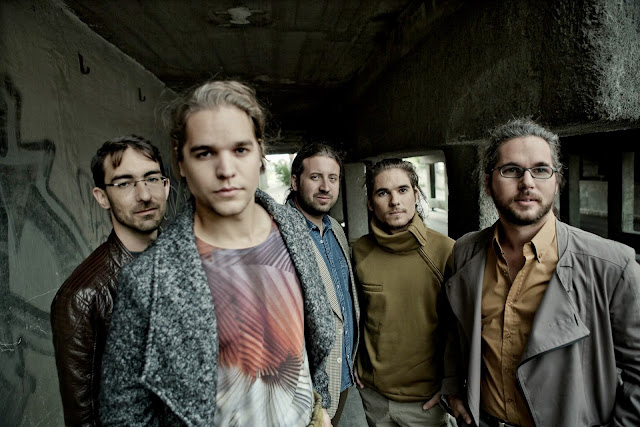
Building from delicate filigree patterns of intertwining strings to dazzling displays of furious fingerwork, Söndörgö (say: shoen-doer-goe) bring a vigorous virtuosity to their fresh interpretations of Hungarian folk music. At the core of their sound is the tambura, a mandolin-like instrument in many sizes, embellished through multi-instrumental skills on assorted wind instruments and accordion. The band got together in 1995 when brothers Aron, Benjamin and Salamon teamed up with cousin David and high-school pal Attila. They've been honing their impressive musicianship ever since, gathering international momentum over five albums – the latest aptly titled 'Tamburocket' - and perfecting the art of bringing audiences to their feet with simply brilliant acoustic folk music.
“their music sparkles with virtuosity and foot-tapping joie de vivre” (Evening Standard)
“a world class band” (The Guardian)